
Are traditional MSBs losing ground to digital players?
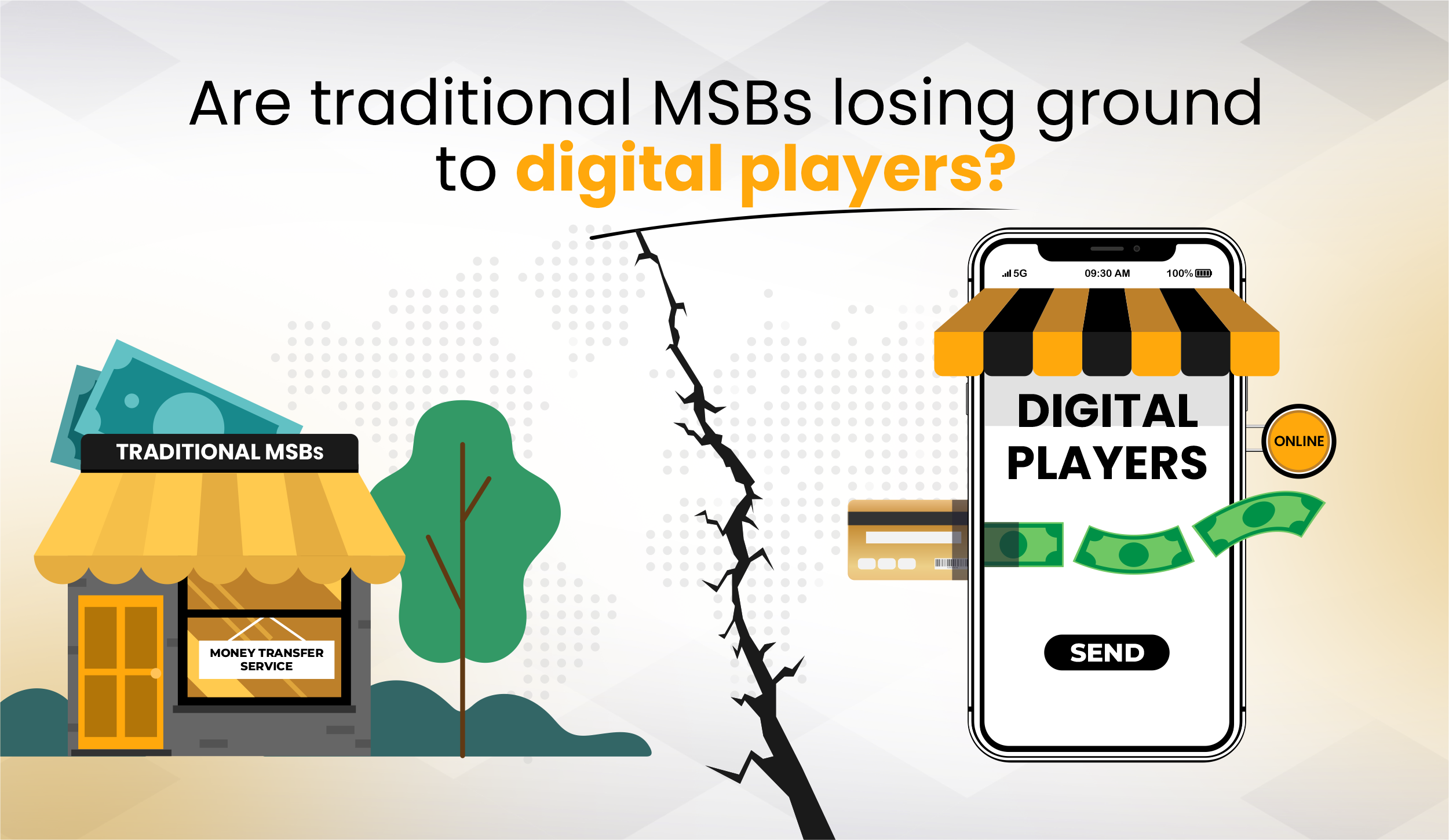
Money Service Businesses (MSBs), including money remittance providers, currency exchange operators, and cheque cashers, play a critical role in the financial ecosystem. For decades, traditional MSBs have served communities through physical branches, face-to-face service, and cash-based transactions, particularly for international money transfers and cross-border payments.
The sector is undergoing major change. Digital-first platforms offering app-based transfers, instant payments, transparent pricing, and competitive rates are reshaping customer expectations around speed, convenience, and cost. This raises a key question: Are traditional MSBs losing ground, or is the industry moving toward a hybrid future?
In this blog, we examine the rise of digital players, the continued strengths of traditional MSBs, and what the future may hold for the sector.
The numbers tell a clear story
The broader remittance market remains strong, with outward flows reaching approximately £9.08 billion, reflecting steady year-on-year growth. Within that expansion, however, the digital segment is growing much faster. The digital remittance market stands at around USD 1.53 billion and is projected to reach USD 3.76 billion by the end of the decade, expanding at a compound annual growth rate (CAGR) of 16.7%. Outward digital transfers already account for the majority share (around 65%), while inward digital flows are increasing even more rapidly in relative terms.
Digital payments overall are also accelerating significantly, expected to grow from USD 11.7 billion to USD 43.7 billion over the coming years (CAGR 15.2%). Industry observers note that the share of outgoing remittances handled digitally has now moved into the majority and continues to rise steadily.
In short, while total money transfer volumes are growing gradually, digital services are capturing most of the new growth, and in many corridors, they are becoming the dominant channel.
Why are digital players growing rapidly?
Several powerful forces are accelerating this shift:
1. Speed and convenience: Traditional transfers via correspondent banking networks can take 3–5 business days, involving multiple intermediaries and complex paperwork (SWIFT codes, IBANs, routing numbers). Digital platforms complete many cross-borders moves in minutes or seconds, with real-time tracking visible to both sender and recipient. In an era of same-day deliveries and instant messaging, waiting days for money feels archaic.
2. Cost transparency and savings: Hidden fees, poor exchange rates, and intermediary deductions have long eroded value in conventional channels. Digital alternatives display the exact amount the recipient will receive upfront, often at near-interbank rates with minimal or zero transfer fees for many routes. For frequent remitters, whether supporting family overseas or paying international suppliers, these savings add up quickly.
3. Accessibility anytime, anywhere: No need to visit a branch during limited opening hours or carry cash. Mobile apps let users send money from their sofa at midnight or while commuting. Features like saved recipients, recurring transfers, and multi-currency virtual accounts make life simpler for freelancers, expats, small businesses, and migrant communities.
4. Technology-driven trust and security: Modern platforms use end-to-end encryption, biometric logins, two-factor authentication, and AI-powered fraud detection. Real-time notifications and detailed audit trails give users confidence that was harder to achieve with paper receipts and phone confirmations.
5. Demographic and behavioural shifts: Younger generations and tech-savvy migrants (the UK has millions of foreign-born residents) naturally gravitate toward apps. The post-pandemic acceleration of digital habits has only reinforced this. Even many older customers have adapted, especially when family members help set up accounts.
Why traditional MSBs remain strong?
It would be wrong to write off traditional operators entirely. Physical locations still serve important niches:
- Cash-based transactions remain relevant for unbanked individuals or those preferring face-to-face service.
- Complex or high-value deals (large corporate FX hedges, unusual currency pairs) often benefit from expert advice in person.
- Vulnerable customers or those in rural areas may value the human touch and established trust built over decades.
- Regulatory familiarity: many traditional MSBs have deep experience navigating anti-money laundering (AML) and know-your-customer (KYC) rules, giving them credibility.
Operational costs are higher, however, rent, staffing, and security for branches eat into margins; while digital models scale with far lower overheads.
The rise of hybrid money transfer models
The smartest traditional MSBs aren’t standing still. Many are investing in their own apps, partnering with fintech infrastructure providers, or offering “click-and-collect” services where customers start a transfer online and pick up cash in-store. Digital-first players, meanwhile, are sometimes adding agent networks or physical pickup points to reach customers who still need cash on the receiving end.
This convergence suggests the future isn’t pure replacement but evolution. The MSB sector as a whole is modernising, with technology enabling better compliance, faster onboarding, and more personalised service regardless of channel.
What’s next for MSBs?
Looking to the remainder of the decade, three trends seem likely:
1. Continued digital growth: Especially in high-volume corridors to Europe, South Asia, Africa, and Eastern Europe. Faster payments infrastructure (including the New Payments Architecture rolling out) will make instant cross-border moves even more commonplace.
2. Regulatory tailwinds and pressures: The FCA and HMRC continue to emphasise innovation alongside robust consumer protection. Firms that embrace technology while maintaining strong AML controls will gain competitive advantage.
3. Customer segmentation: Traditional models will likely retain strength among certain demographics and use cases, while digital captures the mass market. Success will belong to operators who meet customers wherever they are, physically or digitally.
Final thoughts: Adaptation is the real winner
Yes, traditional MSBs are losing some ground, particularly in straightforward, high-frequency consumer remittances and everyday FX. The data on market share shifts and explosive digital growth makes that hard to dispute. Yet the sector isn’t dying; it’s transforming.
The most resilient players will be those that blend the best of both worlds: the trust and expertise built over years with the speed, transparency, and reach that modern technology delivers. For MSBs, the question isn’t whether to fight the digital tide, it’s how quickly and creatively they can ride it.
Consumers ultimately benefit from this competition: cheaper, faster, safer ways to move money. And in a global economy where cross-border flows only continue to rise, that’s a development worth celebrating.
Whether you run a traditional MSB branch network, operate digitally, or are simply someone who sends or receives money internationally, one thing is clear: the future of money services will be defined by those who put customer convenience and innovation first.
References:
- https://www.6wresearch.com/industry-report/united-kingdom-uk-remittance-market
- https://www.marketresearchfuture.com/reports/uk-remittance-market-46509
- https://straitsresearch.com/report/digital-payments-market/united-kingdom
- https://www.grandviewresearch.com/horizon/outlook/digital-remittance-market/uk